
Cannon County Scheduled Release Dates
A scheduled or projected date is a current calculation. An actual release date records what happened after the legal and operational conditions were met. Tennessee FOIL does not label one field “Projected Release Date.” It publishes Release Eligibility Date and Sentence End Date, and those fields answer different questions.
| Field or event | Meaning |
|---|---|
| Release Eligibility Date | The earliest statutory point when parole consideration or another qualifying release may become possible. |
| Sentence End Date | TDOC's calculated end of the sentence, not necessarily the day confinement ends. |
| Parole Hearing Date | A scheduled Board proceeding, not a promise of release. |
| Parole Hearing Result | The Board outcome; even a grant may await plan approval or other conditions. |
| Actual release | The completed departure shown by a later custody status, certificate, or release record. |
A person awaiting trial in Cannon County may have a bond amount or hearing date but no fixed release date. A transfer date also is not community release. It only marks movement to another custodian.
Find Cannon County Projected Release Dates
Choose the route by custodian. FOIL is for Tennessee felony offenders who are currently or formerly in TDOC custody or supervision. Cannon County Jail records and the sentencing court control Cannon County pretrial, misdemeanor, and sentence questions.
- Identify whether the person is in Cannon County Jail, TDOC custody, another county, or a federal system.
- For TDOC, open FOIL and search by name, TDOC ID, or State ID Number.
- Open the matching detail record and read Current Status before any date.
- Compare Release Eligibility Date, Sentence End Date, parole-hearing fields, active sentences, and assigned location.
- For a Cannon County sentence, ask the Cannon County Sheriff's Office and sentencing court for the sentence, jail credits, release entry, and any hold or transfer.
- After the expected day, verify the custody-status change rather than assuming the calculation became an actual release.
A person with only a Cannon County jail stay may have no FOIL record. For a Cannon County court case, the Circuit Court Clerk handles General Sessions criminal and Circuit criminal filings and final dispositions. The judgment can explain the sentence or release authority. The jail entry is better evidence of the physical exit.
The Tennessee Board of Parole FAQ explains that TDOC is the official timekeeper for the Release Eligibility Date.
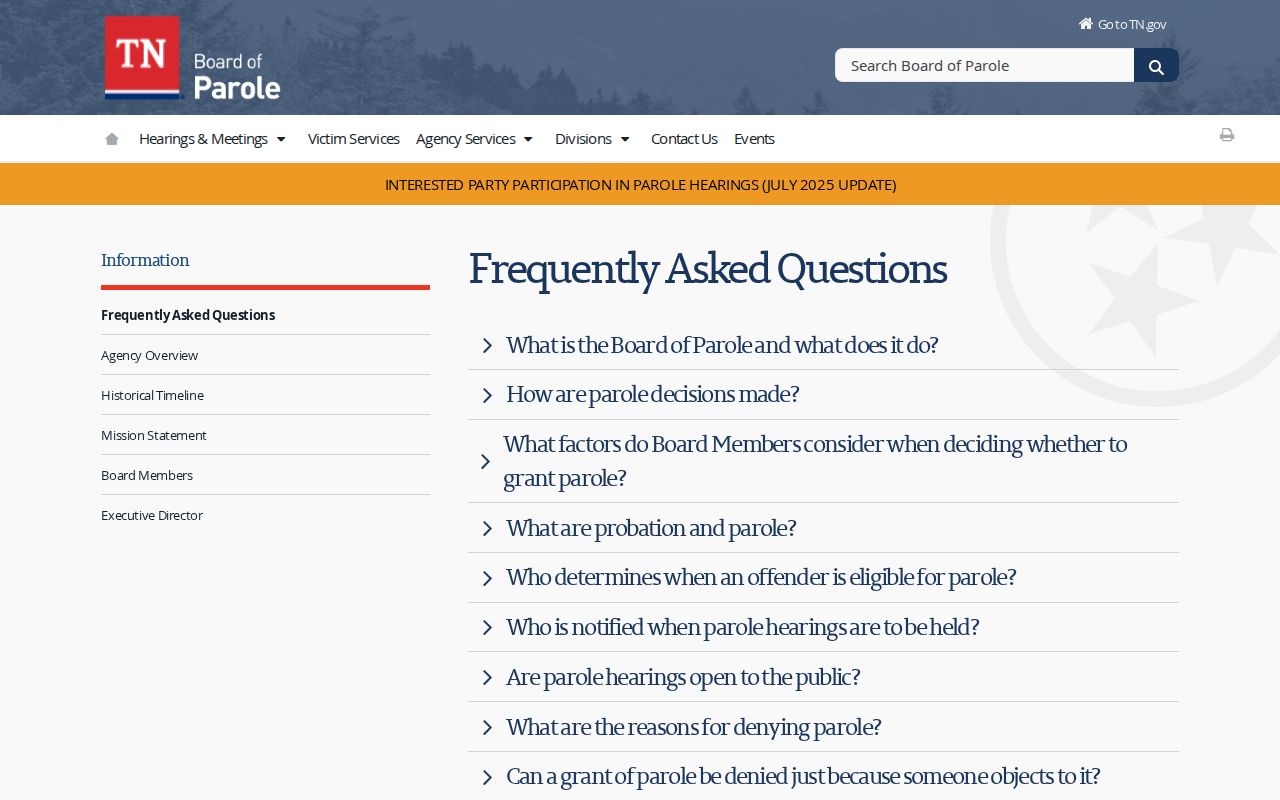
That division of work matters: the judge determines offender classification, TDOC calculates eligibility, and the Board decides discretionary parole.
Cannon County Release Eligibility Rules
Tennessee Code section 40-35-501 establishes ordinary baseline percentages and many exceptions. An especially mitigated offender is generally at 20 or 30 percent as stated in the judgment, with 20 percent when silent. Range I is 30 percent, Range II is 35 percent, Range III is 45 percent, and a career offender is 60 percent.
These are not stand-alone calculators. The controlling sentence, offense date, classification, retained credits, mandatory minimums, and offense-specific provisions must all be applied. Consecutive sentences, pretrial jail credit, detainers, amended judgments, and later documents can materially change the date.
Short felony sentences use another distinction. Ordinarily, felony sentences longer than two years, or consecutive felony terms totaling more than two years, receive regular parole consideration. For a qualifying term of two years or less, the remainder is generally suspended at RED through determinate-release rules. Receipt of all sentencing documents, notice requirements, and consecutive-sentence qualifications still apply. The statute bars release until at least ten days after TDOC receives all sentencing documents and at least ten days after required notice is sent.
Note: Release eligibility creates a point for consideration or a statutory route; it is not an assurance that the person leaves that day.
Cannon County Sentence Credit Distinctions
Tennessee Code section 41-21-236 authorizes sentence-reduction credits. Awards can range from one through sixteen days per month served. No more than eight days per month may come from good institutional behavior, and no more than eight may come from satisfactory program performance. The warden awards credits under TDOC standards. Credits can be reviewed and removed through the disciplinary process.
The offense date and sentence length affect what credits can change. For a sentence under two years, or an offense committed before July 1, 2024, credits can affect eligibility and expiration as the statute permits. For a sentence longer than two years tied to an offense committed on or after that date, credits affect parole eligibility but do not alter sentence expiration. The statute also limits how far credits can reduce the undiminished earliest eligibility point.
County misdemeanors differ again. The court fixes a release percentage of 30, 40, 50, 60, 70, 80, 90, or 100 percent, and credits cannot reduce that percentage by more than 25 percent. No Cannon County jail good-time policy is published, so an exact Cannon County calculation must come from the Sheriff or sentencing court. FOIL is a felony system and should not be used to invent a county-jail date.
The release eligibility statute is shown below in the matched project capture.
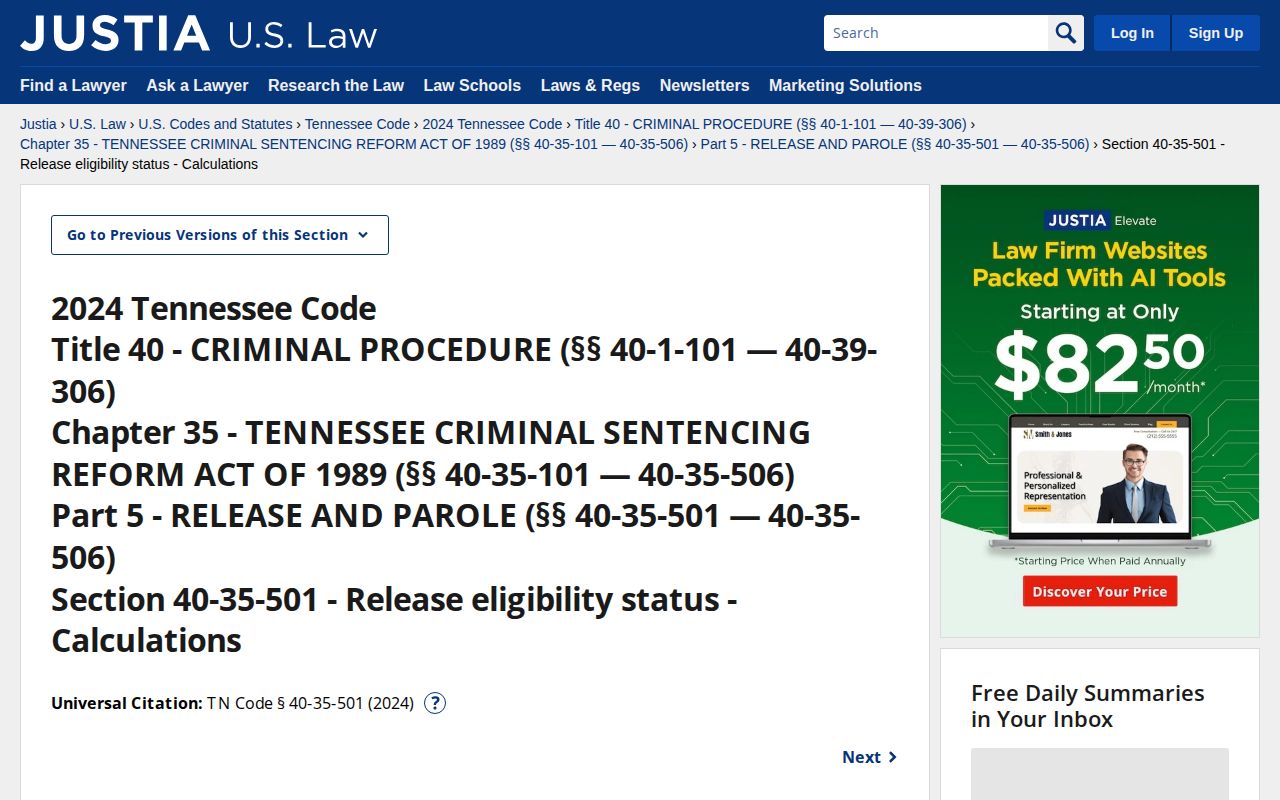
The statute's many offense and date rules are why a simple sentence percentage cannot replace TDOC's published calculation.
Cannon County Has No Universal 85% Rule
Tennessee law does not require every imprisoned person to serve exactly 85 percent. Some listed offenses and date ranges use 100 percent less limited credits, producing the common 85 percent shorthand. Other provisions require 85 percent directly, impose a 100 percent structure with no credit reduction, permit limited reduction of parole eligibility without changing sentence expiration, or provide no release eligibility at all.
Never multiply every sentence by 85 percent. The exact offense, offense date, statutory range, judgment, sentence alignment, and retained credits control. FOIL's Release Eligibility Date is TDOC's public calculation. TDOC should confirm the figure when precision matters.
- Truth in sentencing
- Rules that require a defined part or all of a sentence to be served, with credit treatment set by statute.
- Consecutive sentences
- Separate terms served one after another rather than at the same time.
- Retained credits
- Credits earned and still valid after any disciplinary removal or review.
Cannon County Release Date Changes
FOIL warns that dates can move as additional court documents arrive. The public date is a living calculation, and later legal or custody events may change the expected path.
| Factor | Possible effect | Best confirmation |
|---|---|---|
| New or amended judgment | Changes term, credit, or sentence alignment | Sentencing court and TDOC |
| Credits earned or removed | Moves eligibility when the statute allows | TDOC timekeeping record |
| Parole denied or deferred | Eligibility passes without release | FOIL hearing fields and Board |
| Release-plan conditions | Delays physical release after a grant | TDOC or Board |
| Detainer or another sentence | Causes transfer or continued custody | Holding and receiving agencies |
| County court order | Changes bond, sentence, or Cannon County authority | Cannon County Clerk and jail |
A future Sentence End Date beside parole status is not contradictory. It means incarceration ended but the sentence continues under community supervision. A past RED beside incarcerated status means eligibility passed without a confirmed physical release.
Cannon County Parole Date Limits
The Tennessee Board of Parole schedules a grant hearing only after TDOC reports eligibility. Reaching RED does not compel the Board to release a person. The hearing record can include the offense, criminal and social history, prior supervision, conduct in the institution, program work, the proposed release plan, interested-party input, and other relevant facts. Board Members can adopt, change, or reject a Hearing Officer's recommendation.
A “granted” result still does not establish a physical exit. TDOC says the probation or parole office must approve the release plan, and required pre-parole conditions may remain. A pre-parole rescission hearing can cancel a grant before release. FOIL's later change from incarcerated to parole, the release certificate, or direct TDOC confirmation gives stronger proof that confinement ended.
Denial or a later review date means RED passed without parole through that hearing. The Sentence End Date remains a different calculation. Another release route may apply, but it should be identified in the statute, judgment, or custody record rather than assumed from the passage of time.
Cannon County Jail Date Records
Cannon County provides no public jail roster, date calculator, or published Cannon County good-time policy. A pretrial detainee's next move can depend on bond, dismissal, a plea, a court hearing, or transfer. For a sentenced misdemeanor, the sheriff and court must apply the actual judgment, release percentage, jail credit, and any valid sentence credit.
Call Sheriff Darrell Young's Cannon County Sheriff's Office at (615) 563-5934 with the person's full name, date of birth if known, and approximate booking date. Ask whether the expected exit is community release or transfer and request the existing custody-history or release entry. For the legal basis, contact the Cannon County Circuit Court Clerk, which handles General Sessions and Circuit criminal final dispositions, and request the judgment, bond order, dismissal, probation order, or sentence entry.
The public court docket can show scheduled action but not the completed jail movement. A judge may authorize release before processing finishes, and a detainer may redirect the person to another agency. The timestamped jail entry and receiving-agency record are needed to distinguish those events.
Note: No sourced Cannon County rule supports estimating a weekend release time, property return, or transportation arrangement.
Confirm Cannon County Actual Release
After the expected day, compare FOIL's current status with its date fields. A change from incarcerated to parole supports entry into community supervision. For a Cannon County jail case, request the timestamped release or transfer entry from the Cannon County Sheriff's Office and reconcile it with the Cannon County court judgment.
VINE can provide notice of a custody event, but the exact event still matters. Registering through the Cannon County VINE inmate check can flag release or movement while the official jail or TDOC record supplies the durable confirmation.
The official Cannon County sheriff directory entry provides an alternate confirmation of the Cannon County contact. For older TDOC material beyond the public display, use the TDOC archived-record request. Identify the person, known IDs, date range, and requested record. Archive search charges may apply, so request a cost estimate and do not prepay.
Keep a copy of the current public result because a later calculation may change after TDOC receives new sentencing material.
Note: The later custody status is stronger release proof than a projected date viewed before the expected exit.