
Cannon County Parole and Probation
Tennessee divides post-release authority among the Tennessee Board of Parole, the Tennessee Department of Correction, and the sentencing court. The Board of Parole decides whether an eligible imprisoned felony offender receives parole. It also decides parole warrants, revocation, and reinstatement. TDOC Community Supervision manages both felony parole and felony probation in the community. A sentencing court keeps authority over probation decisions, including revocation and reinstatement.
Parole is a conditional release from incarceration before the sentence ends. Probation is a court-ordered community sentence. It may be imposed from the start or after split confinement, which combines time in custody with time under supervision. That distinction matters when checking a Cannon County release. A parole status supports the conclusion that imprisonment ended. A probation status alone does not prove a person was released from prison.
| Point | Parole | Probation |
|---|---|---|
| Who places the person | Tennessee Board of Parole | Sentencing court |
| What it shows | Release from incarceration while the sentence continues | Community supervision that may or may not follow custody |
| Field supervision | TDOC Community Supervision | TDOC for felony probation, or a Cannon County office when the court assigns Cannon County probation |
| Best proof | FOIL status, approved release plan, or parole certificate | FOIL plus the judgment or probation order |
- Discharge
- The end of the sentence or supervision obligation, not merely the end of confinement.
- Absconder
- A supervised person alleged to have stopped reporting or left supervision without permission.
- Detainer
- A request by another authority to hold or receive a person after the current custody ends.
Verify Cannon County Release Supervision
The official online route is the Tennessee Felony Offender Information Lookup, known as FOIL. It covers felony offenders currently or formerly in TDOC custody or under TDOC supervision. A county-only pretrial or misdemeanor stay may produce no result. For that type of Cannon County release, the sheriff's release entry and the court file remain the direct records.
- Search by name, TDOC ID, or State ID Number. A name search may include matching aliases.
- Complete the case-sensitive CAPTCHA and open the record that matches the person's identifiers.
- Read Supervision Status first. Parole, probation, incarcerated, and inactive describe different states.
- Compare Assigned Location, Sentence End Date, active Tennessee sentences, and the parole-hearing fields.
- Use the TDOC field office directory to identify the office tied to the record.
- Ask the correct office to explain an unclear or apparently stale entry. Some case details remain confidential.
FOIL's inactive label is consistent with no active TDOC custody or supervision, but it does not name the exact discharge event. A future Sentence End Date beside parole status means the person left confinement while the sentence continues. A probation result should be checked against the court judgment because probation may have been ordered without a prison term.
Note: A FOIL result verifies state felony status, not every short stay or community release from Cannon County Jail.
Cannon County Supervision District
Cannon County belongs to TDOC District 50. The state directory groups Bedford, Cannon, and Rutherford Counties under the Murfreesboro reporting location. District 50 as a whole also serves Coffee, Franklin, Lincoln, Marshall, and Moore Counties. The assigned location on a person's FOIL record should guide contact because supervision can be moved or reassigned.
TDOC District 50
1711 Old Fort Parkway, Suite C
Murfreesboro, TN 37129
Phone: (615) 898-8030
Fax: (615) 848-5110
The official directory image shows the state route for Cannon County supervision. Review the TDOC District 50 listing before calling.
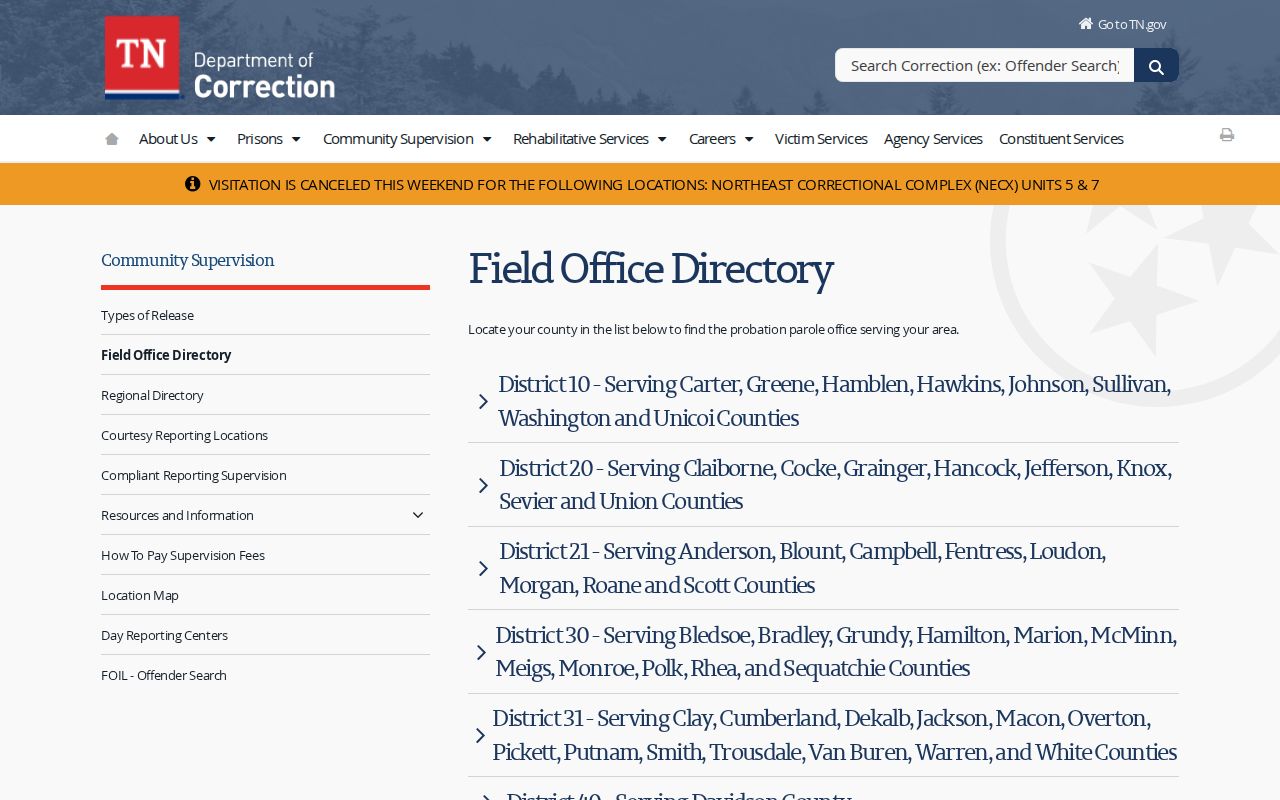
The listing helps identify the office, but the FOIL Assigned Location field is still needed for a person-specific match.
Cannon County Supervised Release Types
TDOC describes several routes that can place a person in the community. A parole grant is not a completed physical release. The release plan must be approved, and pre-parole conditions may delay the move. For probation after split confinement, TDOC says the person must report to the probation or parole officer within 48 hours of release. The judgment and jail release record are stronger proof of the exit itself.
- Parole: early community release by the Board, subject to conditions and TDOC supervision.
- Determinate release: a form of probation for qualifying felony sentences of at least one year but no more than two years, subject to statutory notice and document rules.
- Mandatory reentry supervision: a route under Tennessee Code section 40-35-506 for qualifying offenses, with limits for detainers, pending charges, and specified custody or disciplinary circumstances.
- Community Supervision for Life: separate TDOC supervision that begins after the applicable prison, probation, or parole term for specified offenses.
A transfer from Cannon County Jail to TDOC is not community release. It ends the Cannon County booking while state confinement continues. For the Cannon County exit, the Cannon County Sheriff's Office under Sheriff Darrell Young holds the jail record. The Cannon County released-inmate search path explains how the jail record and court disposition establish that Cannon County custody transition.
Cannon County Probation Reporting Rules
Cannon County also operates a local Probation Department. Its published page is a reporting and payment channel, not a public name search. It must not be confused with TDOC District 50. A court order should show whether a person reports locally or to state felony supervision.
Cannon County Probation
Director Jessica Duncan
110 S. Tatum St.
Woodbury,
TN
Phone: (615) 947-8929
Fax: (615) 563-0521
Reporting: Mondays, 9:00 a.m. to 5:30 p.m.
cannoncountyprobation@gmail.com
The Cannon County office accepts money orders payable to “CCP” or “Cannon County Probation” in its drop box. That logistical detail identifies the office's payment process; it does not reveal whether a named person is supervised there. Direct case questions must follow the court order and the office's disclosure rules.
The Cannon County reporting page is captured below. Its posted hours and payment instructions distinguish this county office from statewide TDOC supervision.
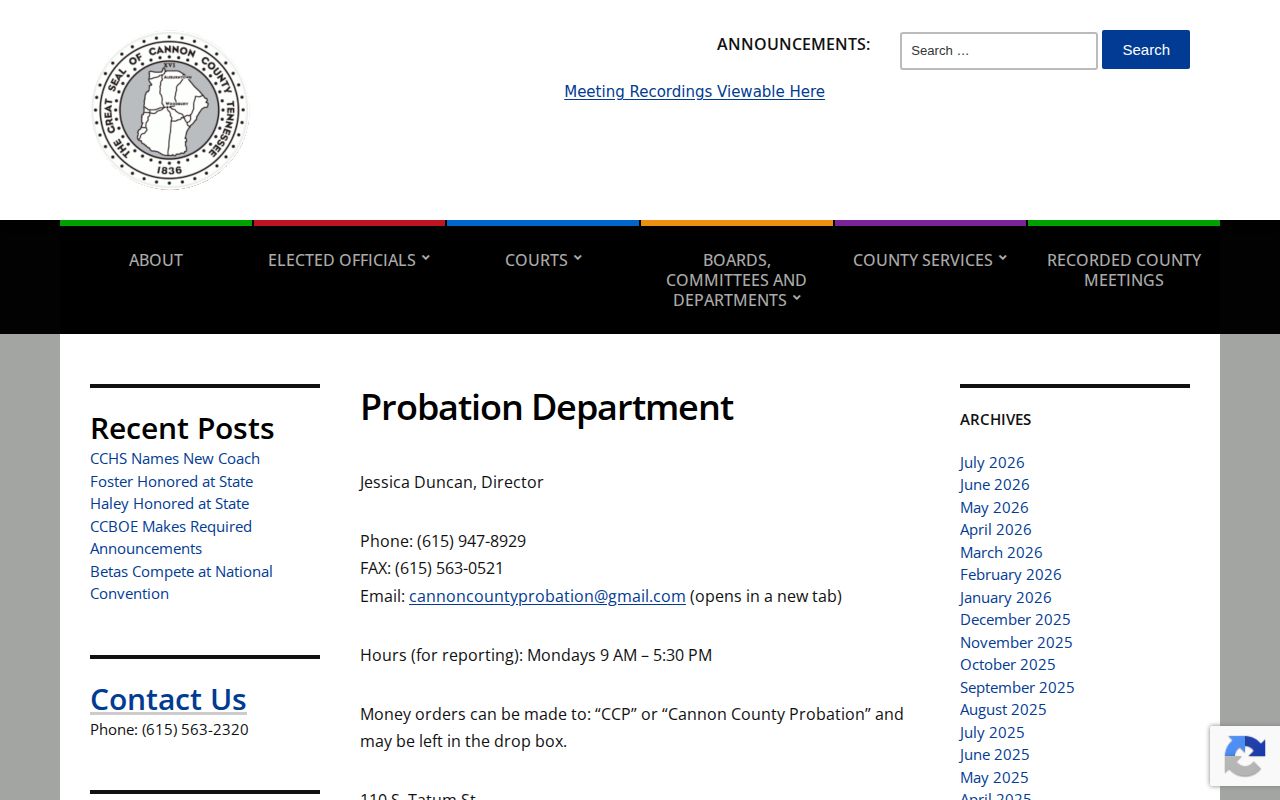
The county page confirms practical reporting details, while the judgment remains the record that assigns local probation.
Note: The local office's reporting details do not identify a named person's supervision assignment or current status.
Cannon County Supervision Warrants
No separate official statewide TDOC absconder or probation-warrant name search was found in the researched Tennessee channels. FOIL may show current supervision information, but it is not a complete active-warrant database. An absent record or inactive status must not be read as proof that no warrant exists.
For parole, the Board decides warrant issuance, revocation, and reinstatement. For probation, the sentencing court has that authority. A suspected Cannon County warrant should be checked with the correct court, law-enforcement agency, Board, or supervising office. VINE reports custody events and notifications; it does not replace a warrant check.
Cannon County Release Conditions
Conditions are the rules attached to community supervision. The exact terms come from the Board's parole certificate, the court's probation order, and instructions issued by the supervising officer. They should not be reconstructed from a short public status label. At a high level, supervision can require reporting, an approved residence or release plan, compliance with court orders, and completion of specified programs. Some information about an individual's plan is confidential.
A reported violation begins a process; it is not itself a final revocation. For parole, Board proceedings can include a preliminary revocation hearing to address probable cause and a final hearing to decide whether parole was violated. The Board may revoke or reinstate supervision. A pre-parole rescission can cancel a grant before the person leaves custody, while a post-parole rescission or revocation concerns events after parole status began.
Probation follows the sentencing court. The court decides whether to revoke or reinstate it, even though TDOC may supervise the felony case in the field. This is why FOIL, the court docket, and a jail roster answer different questions. FOIL reports the state status. The court supplies the controlling order. A custody record shows whether an arrest or detention actually occurred.
Cannon County Supervision Discharge
Release from a jail or prison is not the same as discharge from a sentence. Parole can continue until the sentence end date, and probation lasts until the court-ordered term ends or the court changes it. Mandatory reentry supervision and Community Supervision for Life have their own statutory structures. A person may therefore live in Cannon County, be out of confinement, and still have a state reporting duty.
To verify that supervision ended, read the current FOIL status together with Sentence End Date and active Tennessee sentences. An inactive result is useful but does not state the exact mechanism. When the date or authority matters, request confirmation from TDOC or the originating court. For an older state file that is no longer fully displayed, TDOC's archived-record process asks for the person's name, known identifiers, the record sought, and requester contact details. Search charges may apply, and TDOC advises requesters not to prepay.
A local Cannon County probation term requires the court file rather than an assumption based on FOIL. Obtain the final order, discharge entry, or other public disposition from the clerk. That record can show that the court ended supervision even when an operational portal has not yet caught up.
Cannon County Release Recovery Court
Cannon County operates a named Recovery Court. Its official description includes treatment, cognitive behavioral therapy, counseling, recovery-support meetings, and frequent court appearances. This is a court-supervised local program, not a general service assigned to every released person and not a substitute for parole or probation verification.
Coordinator Chris Carter is available by appointment at 120 South Tatum Street in Woodbury, by phone at (615) 775-0565, or by email at ccarterrecovery@gmail.com. The official Recovery Court page should be used to confirm current access. Participation comes from the court process, so a person should not be assumed enrolled based only on a release or supervision record.
Note: Recovery Court is a specific court program, while District 50 and Cannon County Probation supervise different classes of cases.